

Special thanks to our guest contributor Rebecca Kelly at the Newark Earthworks for bringing her expertise to this month's blog.
Let me tell you about one of my favorite moments when teaching at the Hopewell Ceremonial Earthworks.
I show students an image of the Squier and Davis map—this beautifully detailed 1800s map of the Newark Earthworks—and I ask them what seems like a very simple question:
“What do you see?”
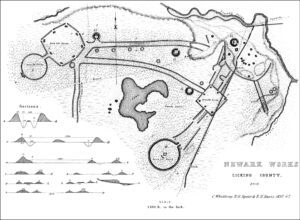
Map of the full Newark Earthworks Complex as mapped by Ephraim Squier and Edwin Davis in 1848 for the publication Ancient Monuments of the Mississippi Valley.
And then… we wait.
If you’ve ever tried this, you know the feeling. The silence stretches just a little too long. Students start to shift in their seats. Someone inevitably tries to jump ahead and explain what it is instead of just describing what they notice.
And I gently pull them back.
“Just tell me what you see.”
No guessing. No interpreting. Just looking.
This is the heart of See–Think–Wonder, a routine from Harvard Graduate School of Education’s Project Zero that sounds simple but can completely transform how students engage with learning.
But I’ll be honest—this first step is the hardest one.
For students, slowing down feels unnatural. For educators, it can feel even harder. We want to help. We want to guide. We want to get to the “right answer.” But when we pause and give students time, something really powerful begins to happen.
At first, the observations are simple. Lines. Circles. Squares. Shapes connected together. Pathways that don’t quite make sense yet. But as more students begin to share, you can actually see their confidence grow. They start to realize there isn’t just one right answer—there’s value in what they notice.
Once we’ve really sat in that space, I shift the question just a little: “What does this make you think of?”
And suddenly, the map starts to feel less distant.
Students begin making connections to their own lives. It looks like roads. Or a fort. Or something built with blocks. Sometimes someone says it reminds them of a map they’ve seen before, or even a game board. This document—created nearly 200 years ago to record earthworks built over a thousand years before that—starts to feel familiar.
That’s the moment I’m looking for.
Because now, it matters to them. And then we move into my favorite part. “What does this make you wonder?”
This is where everything opens up.
"Why are the shapes so precise?"
"Why are there long, straight, parallel walls?"
"Who made this—and how?"
"What was it used for?"
"Why did someone feel the need to map it?"
The questions come faster now, and they’re deeper. You can almost feel the shift in the room. Students aren’t just looking anymore—they’re thinking. They’re questioning. They’re trying to make sense of something bigger than themselves.
And the best part? I didn’t give them any of those questions.
They got there on their own.
From that point on, everything we explore—the people of the Hopewell culture, the purpose behind these massive geometric spaces, the sheer knowledge and effort it took to build them—has a foundation. The learning sticks because it’s rooted in their own curiosity.
In a time when students can find almost any answer in seconds, I’d argue that our job as educators isn’t just to deliver information. It’s to help students slow down. To notice. To connect. To wonder.
Because once they start wondering, they’re already on the path to understanding.
So here’s a small invitation for your own classroom: think about something you already use—a photo, an artifact, a map, even a diagram. What might happen if you resisted the urge to explain it… and simply asked:
“What do you see?”
You might be surprised by what your students show you.
Key Resources:
See-Think-Wonder routine from Harvard Graduate School of Education’s Project Zero
Squier, Ephraim George and Edwin Hamilton Davis. Newark Earthworks map. 1846. Ohio History Connection. Columbus. From Ohio Memory. https://ohiomemory.org/digital/collection/p267401coll7/id/1205/rec/72.
Hopewell Ceremonial Earthworks website, featuring informative sections on the history and culture of the Hopewell Ceremonial Earthworks.
Educational Resources:
Indigenous Wonders: Hopewell Ceremonial Earthworks Museum in a Box- Centered on Ohio's only UNESCO World Heritage site, this resource kit features carefully curated artifacts and replicas, maps, images, and three complete lesson plans. This Box explores the history, math and science of the Hopewell Ceremonial Earthworks. Learn more here.
Indigenous Wonders Virtual Learning Experience- Engage your students with Indigenous Wonders, a live, virtual program about the ancient Hopewell Ceremonial Earthworks—astonishing World Heritage sites built 2,000 years ago in what we now know as Ohio. The programs has four segments: World Heritage, Artifacts, the People and Ancient Knowledge, using demonstrations, videos and interactive questions.
Build Background Knowledge
Websites
Ohio Memory, from the Ohio History Connection and the State Library of Ohio, features a variety of primary and secondary sources relating to the Hopewell Ceremonial Earthworks.
“Hopewell Culture National Historic Park” website from the National Park Service.
The Ancient Ohio Trail from CERHAS – University of Cincinnati and Newark Earthworks Center – The Ohio State University at Newark.
Books, Etc.
Hancock, John E. Hopewell Ceremonial Earthworks: Ohio, United States of America, Nomination to the World Heritage List by the United States of America, 2022. World Heritage Ohio, 2022.
Indigenous Wonders of the World. Exhibition. Columbus, Ohio: Ohio History Connection. Ohio History Center.
Kern, Kevin F. and Gregory S. Wilson. Ohio: A History of the Buckeye State (Wiley-Blackwell, 2013).
Leper, Brad, PhD. Ohio Archaeology: An Illustrated Chronicle of Ohio’s Ancient American Indian Cultures. Orange Frazer Press, 2005.
Squier, E.G., and E.H. Davis. Ancient Monuments of the Mississippi Valley. 150th Anniversary Edition. Smithsonian Books, 1998.
Blog Image Citation: Squier, Ephraim George and Edwin Hamilton Davis. Newark Earthworks map. 1846. Ohio History Connection. Columbus. From Ohio Memory. https://ohiomemory.org/digital/collection/p267401coll7/id/1205/rec/72.