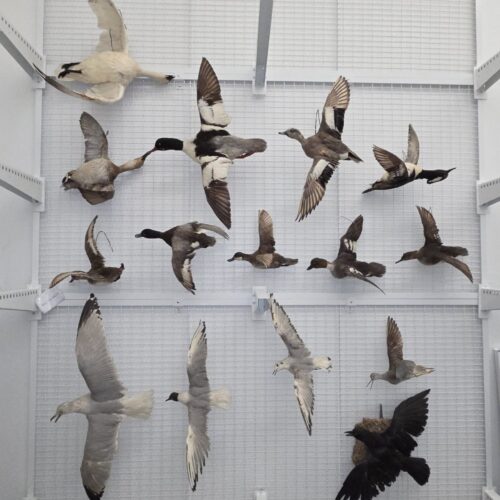
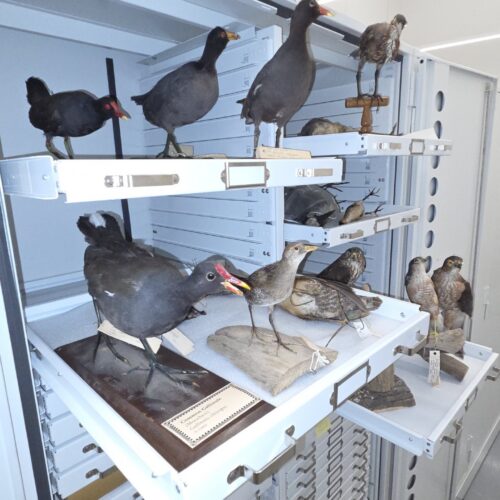
Our bird taxidermy specimens are on the move! As part of Ohio History Connection’s Campus 2.OH initiative, we’re relocating our history and natural history collections to our new Collections Care Center. To date, we’ve packed, moved and unpacked 442 birds; that’s a lot of feathers! Now, our most fragile specimens are stored in a stable environment with state-of-the-art museum cabinets. Many of the larger birds mounted in flying poses will be hung from wall racks (see above) originally designed for artwork.
Moving is never easy, but one of the benefits (besides the new space) is we get to see each individual specimen at least twice, once when packing and again when unpacking. This allows us to examine the condition of the birds and check for the presence of insect pests like moths and yikes, dermestid beetles! (See previous blog about beetles here.) Fortunately, we didn’t find any pest issues on our specimens during the move.
Seeing the birds up close gave me a renewed appreciation of the diversity and beauty of these freaky little dinosaurs! Curators are often asked what our favorite collections objects are; so, I wanted to share a few bird taxidermy mounts that make my list.
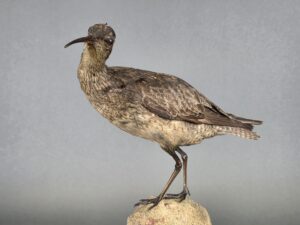
The Eskimo Curlew, a member of the sandpiper family, is now listed as “likely extinct”. It used to be one of the most common shorebirds in the arctic regions of Alaska and western Canada. It migrated through the eastern United States on its annual journey to South America. But the last definitive documentation of this species was in1963. I had the sobering task of moving this mount from the general collection to the special cabinet that houses other extinct birds including the Passenger Pigeon, Carolina Parakeet, and Ivory-billed Woodpecker.
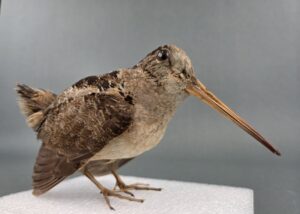
The Woodcock, an odd but endearing bird, is also a member of the sandpiper family. It lives in woodlands and uses its long beak to poke around in soft ground looking for invertebrates. The position of its eyes far back on the head allows the Woodcock a 360-degree view of its environment.
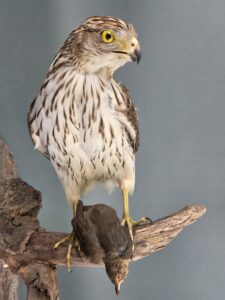
You may have seen this crow-sized Cooper’s Hawk in your own backyard. Cooper’s Hawks have adapted well to cities and are now found more often in urban areas than in their natural forest habitat, due to the abundant food source. They love backyard birdfeeders… or rather, the small, tasty birds that visit them!
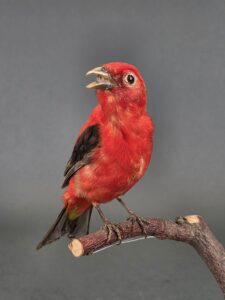
Was that flash of red a Northern Cardinal? Probably, but during summer months in Ohio be on the lookout for the Scarlet Tanager. The breeding males are bright red, but their black wings distinguish them from cardinals. They like to hang out in the canopy of hardwood forests.
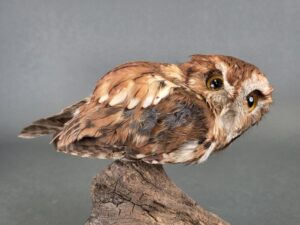
The most common owl in Ohio is the Eastern Screech Owl, which is found in every county in the state. Eastern Screech Owls come in two main color phases, gray or red; the latter is seen in this photo. A small owl, it feeds on everything from invertebrates to other birds.
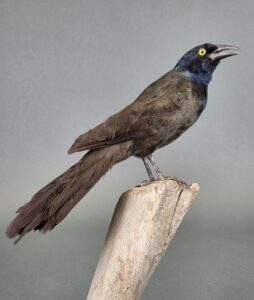
You may overlook the Common Grackle, a regular visitor to bird feeders in the spring and summer. But a close look reveals the beautiful iridescent feathers - showing glimmers of purple, bronze, and green, and their stunning yellow eyes!
The taxidermy birds in our natural history collection are nestled into their new state-of-the-art storage patiently waiting for their turn to be used in an exhibit, educational program, or research project!
Have an interest in birds? You’ll love the free app “Merlin Bird ID” developed by the Cornell Lab of Ornithology. It helps you identify birds by their sound or appearance. I especially like the sound feature because it shows you what species are nearby including those that might be too far or hidden to see.