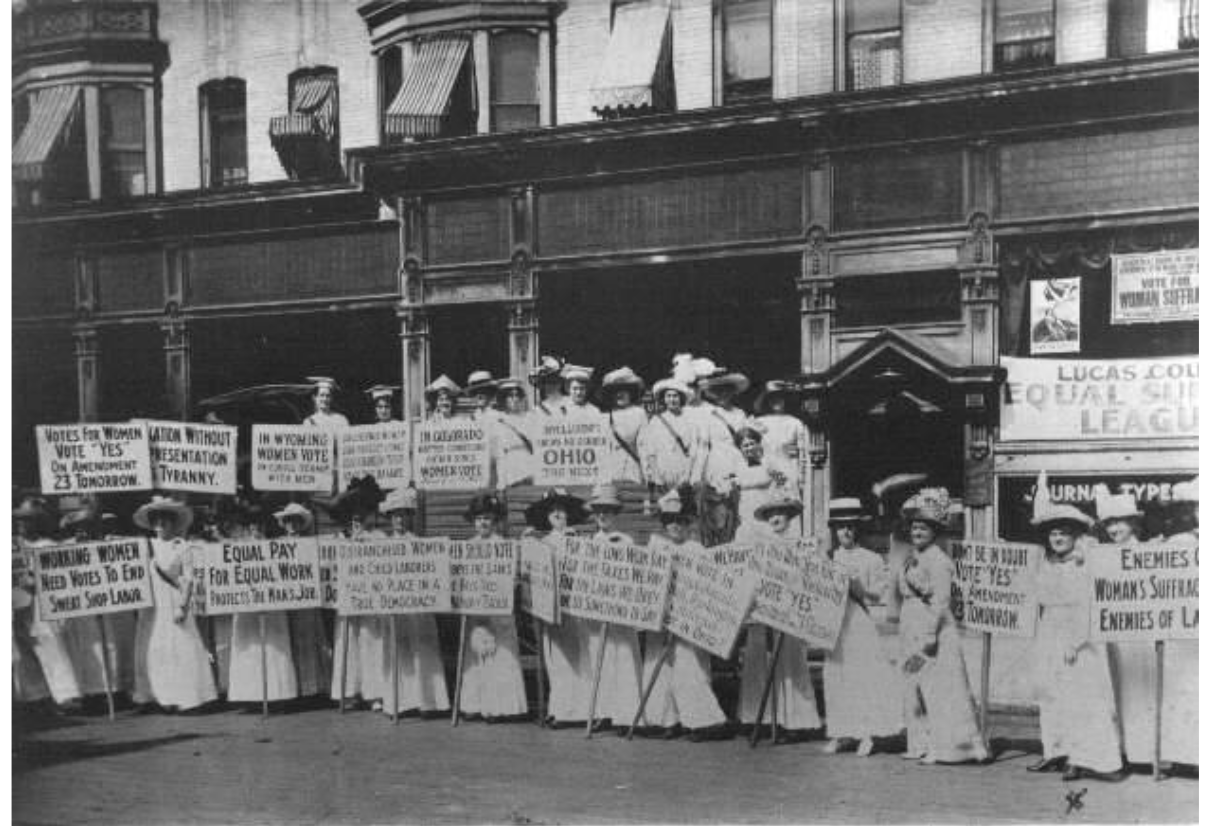
They’ve started popping up everywhere. One at your neighbor’s house and the sidewalk down the block. The green space around the corner and that busy intersection are both covered in them. The election sign deluge for this November’s general election has begun. And as any educator knows, the run-up to this year’s election presents a great opportunity to engage students in learning about civics, from the history of suffrage in the United States, to helping students seem themselves in the electoral process and beyond. At Resource Roundup, we’re helping you take advantage of this opportunity by providing resources, activities, and historical context so you can focus on what you do best: shaping Ohio’s young minds. In part one of this series, we’ll be diving into the life of one of Ohio’s most famous and controversial figures in the women’s suffrage movement: Victoria Woodhull.
Born in Homer, Ohio in 1838 as Victoria California Claflin, Woodhull is best known today as the first woman to run for President. As a the seventh of ten children, Woodhull participated in the family trade of patent medicine and healing through the 1860s. Woodhull met her first husband, Canning Woodhull, and married at the age 15. Victoria and Canning had two children together, Byron and Zulu Maude, but Canning quickly proved to be an alcoholic, big spender, and frequenter of brothels. After 11 years of marriage, Victoria divorced Canning in 1864.
Historians point to Woodhull’s tumultuous first marriage as the likely origin of her passion for the Free Love moment, which argued that women should be allowed to marry, divorce and have children without the interference of the government and society more broadly.
Victoria Woodhull married Colonel James Harvey Blood, also a believer in Free Love, in 1866. Woodhull moved to New York City with her new husband and sister Tennessee Claflin, where the sisters became friends with Cornelius Vanderbilt, one of the wealthiest men in America, and with his partnership became the first women to operate a financial firm on Wall Street. The sisters also started their own newspaper called Woodhull & Claflin’s Weekly, which they used to advocate for women’s suffrage, free love and other progressive issues, as well as to expose alleged scandals.
With growing notoriety and political connections, Woodhull began to gather a following. She hosted speeches, published articles and made a name for herself. In 1871, Woodhull became the first woman to address Congress. A year later in 1872, Woodhull accepted the nomination to run for President as a member of the newly formed Equal Rights Party with Frederick Douglas as her vice president, though Douglas never acknowledged the nomination. Though Woodhull received few votes, her nomination served to illuminate the great irony of being a woman in the United States before the passage of the 19th ammendment: Woodhull was legally allowed to run for President, but could not case a vote in the election. Woodhull’s unsuccessful nomination was ultimately one of the first stepping stones that led to women earning the right to vote in 1920 when Victoria was eighty-two years old.
Woodhull, though often considered controversial in her time, was an active participant in the women’s suffrage movement, pushing women’s rights and protections, ultimately contributing to the movement that earned women the right to vote in 1920 with the passage of the 19th amendment.
Classroom Activity:
As election campaigns kick into high gear this fall, your students are stepping into the driver’s seat. First, they’ll investigate some of the posters, broadsides, postcards and pamphlets created during the women’s suffrage movement. Then, they’ll investigate a modern political issue and create their own political ephemera for their selected issue.
1. First, students should examine a selection of women’s suffrage materials (see below). Depending on your classroom’s needs, you may opt to have students examine the primary sources individually or in small groups. Adapt the number of sources they examine according to your classroom needs. Students should be able to answer:
- Who created this poster/broadside/postcard/sign? What information does the creator want to communicate to the viewer?
- What can we learn about the women’s suffrage movement by examining this primary source?
- What stands out to you about this primary source? What makes this an effective or ineffective political poster/ broadside/postcard/sign?
- Do you think any of the primary source’s claims or design elements would be less effective today than when it was created? Why or why not?
Primary Source Set:
2. Now it’s your students’ turn. Your students are now running their own campaign for an issue they feel is important in today’s world (we know, it seems like just yesterday they were learning about the electoral college in your classroom—time flies!). Students should select one topic they want to feature in their campaign. What issue matters the most to them?
- Once they’ve selected their issue, students should conduct research into the issue. The goal of their research is to be able to create a compelling piece of campaign material. They don’t need to become political experts in the issue, but they’ll need to understand the basic positions held on their issue of choice, as well as the basic arguments for and against the issue.
- Note: High school and older middle school teachers may wish to host a class discussion to determine what political issues matter the most to your students. Elementary and some middle grade educators may wish to create a set list of topics for students to select from (e.g., environmental protection, affordable college tuition, voters’ rights, etc.). As students research their chosen issue, elementary and middle school teachers may wish to provide students with a select list of resources for students to use in their research.
3. Armed with their research and reflections on historical campaign materials, now it’s time for students to get creative. Their goal is to create a piece of political material advocating for their chosen issue.
- Students should create a poster advertising a speech, a political banner, poster, a song, etc. for their chosen issue.
- Encourage students to get creative! They should be making something they think would truly be eye-catching and compelling to young people today. The campaign material should be compelling, clear, and integrate what they’ve learned throughout the activity.
- Once students have put together their political ephemera, it’s time for them to show it off! Host a class gallery walk as students display their work.
Additional resources to dive deeper into researching women’s suffrage:
Blog Image Citation: [Left] Davis, Cornelia Cassady. Lucas County Equal Suffrage League, Toledo, Ohio, 1912. Toledo: 1912. Ohio Memory, Parades - Women's Suffrage - 6394. https://ohiomemory.org/digital/collection/p16007coll33/id/190011/rec/10 (Sep. 7, 2026).
[Middle Left] Woman Suffrage Party of the City of New York. "Votes for Women!" broadside. New York: ca. 1900. Ohio Memory, Hopley Family Collection, 1866-1902. https://ohiomemory.org/digital/collection/p267401coll32/id/27667/rec/100(Sep. 7, 2026).
[Middle Right] Victoria Claflin Woodhull portrait. ca. 1870. Ohio Memory, Victoria Claflin Woodhull Collection. https://ohiomemory.org/digital/collection/p267401coll32/id/9628/rec/1 (Sep. 7, 2026).
[Right] Ohio Woman Suffrage Association. Ohio Woman Suffrage Association broadside. Warren, Ohio: ca. 1910. Ohio Memory, Ohio Woman Suffrage Association Broadside Collection. https://ohiomemory.org/digital/collection/p267401coll32/id/27660/rec/9 (Sep. 7, 2026).