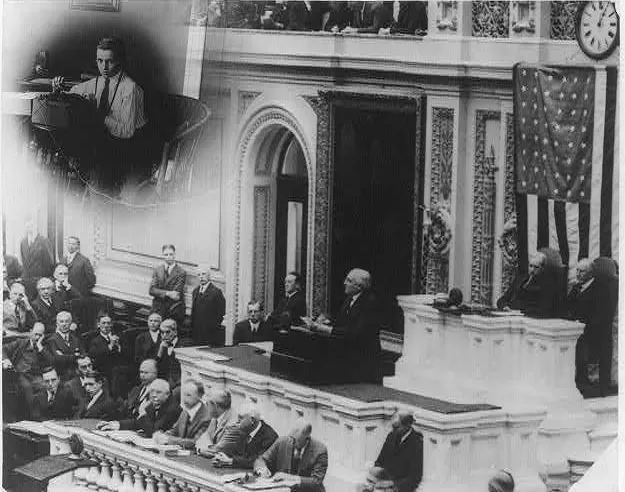
1. The central part of this paper—focusing on details surrounding the broadcasting of the President’s speech—is based primarily on information from one primary source: S. R. Winters’ informative article, “Broadcasting the Presidential Message to Congress.” It appeared in the April 1923 issue of Commercial America on pages 27, 29. This article is available over the Internet at: https://earlyradiohistory.us/1923mes.htm. (What appears to be an earlier, briefer version of this article, entitled the “President’s Voice Wafted Over U.S.,” appeared in the The Evening Star [Washington, DC] on December 8, 1922, on the front page.)….Another important source of useful background information on the Annual Message itself and about radio’s presence in the Congress is found on various pages of the House of Representatives website: https://history.house.gov/Home/ . Also used were notes, dating from 2010, based on a now defunct House website. These resources were drawn upon extensively in preparing this paper.
2. Harding’s first Annual Message had been delivered, without radio, on December 6, 1921. According to historian Robert K. Murray, this address laid out the framework for his normalcy program and is considered to be one of his best speeches (See Robert K. Murray, The Politics of Normalcy [New York: W. W. Norton, 1973], p. 46)….Presidents
George Washington and John Adams both delivered their Annual Messages in-person. But from President Jefferson through President Taft, the Annual Messages were sent by messenger to the Congress, where they were read by the Clerk of the House. President Woodrow Wilson revived in-person delivery of the Annual Message in December of 1913. Harding followed Wilson’s lead….Until 1934, the Annual Message was delivered every December. Since then, it has been delivered every January or February.
3. Robert K. Murray, The Politics of Normalcy (New York: W. W. Norton, 1973), 92.
4. In the 19 th Century, Annual Messages were much longer and didactic. Presidents Benjamin Harrison and Grover Cleveland’s messages never came under 12,000 words and on two occasions both exceeded 30,000 words. These messages dealt mostly with what had been done. President Wilson, who resumed in-person delivery of the Annual Message, focused on the current situation and what legislation was needed to handle the nation’s problems, and President Harding would do the same. (See the Kansas City Kansans, Dec.12, 1922, p. 4.)
5. See: https://hardingpresidentialsites.org/2022/05/29/first-presidential-radio-broadcast-marks-100-year-anniversary/
6. The amplification system was removed from the House in 1924 due to members complaints. It would be several years before a satisfactory system would be in put in place.
7. See: https://history.house.gov/Historical-Highlights/1901-1950/The-first-live-radio-broadcast-of-a-House-debate-transpired/
8. Only a few days after President Harding delivered his Annual Message, there was a broadcast, again over NOF, of a debate on the House floor regarding a Constitutional amendment to eliminate tax-exempt securities. This took place on December 19, 1922. It would be 50 years, however, before regular live broadcasts of House proceedings took place.
9. “May Be Broadcast,” Battle Creek (MI) Enquirer, Dec. 1, 1922, p. 4.
10. Among the key stations broadcasting the President’s address were: KDKA (Pittsburgh), WEAF (New York City), WJZ (Newark), WMAQ (Chicago), WWJ (Detroit), WDAF (Kansas City), and WHAS (Louisville). Most of these stations were Class B Stations broadcasting on 400 meters; that is, they were several steps above the average station of that day. See “Broadcasting Station Directory,” Wireless Age (January 1923), pp. 44-45….By 1922, three million homes had radio receivers. As Secretary Herbert Hoover, who oversaw radio, observed that radio had moved on “from the field of adventure to that of a public utility.” See Robert K. Murray, The Harding Era (Minneapolis: University of Minnesota Press, 1969), p.410.
11. “Is Heard By Radio Fans,” The Huston Post, Dec. 9, 1922, p. 1.
12. “Harding to Read Message Today At Joint Session,” The Washington Herald, Dec. 8, 1922, p. 1
13. The first Annual Message to be delivered in the evening was on January 3, 1936. President Franklin D. Roosevelt’s decision to do so was based on a desire to reach the largest possible radio audience. This was the second time a Joint Session of Congress had gathered to hear an evening presidential address, the first being on an April night in 1917, when President Woodrow Wilson asked Congress for a declaration of War against Germany.
14. The Republican Party Congressional candidates had taken a shellacking in the November 7, 1922, election. The Party retained control of both Houses but with significantly reduced majorities: from 165 to 22 in the House and from 15 to 6 in the Senate. The new 68 th Congress would pose more problem for President Harding, especially with the rise of the Farm Bloc.
15. See the approving front page cartoon in The Evening Star (Washington, DC), Dec. 9, 1922. The farmer and the laborer like what Harding had to say.
16. The Wilkes-Barre (PA) Times Leader, Dec. 8, 1922, p. 1; and “President’s Voice Wafted Over U.S.,” The Evening Star (Washington, DC), Dec. 8, 1922, p. 1.
17. David Lawrence, “President Covers All Major Issues,” The Evening Star (Washington, DC), Dec. 8, 1922, p. 1.
18. Robert K. Murray, The Politics of Normalcy (New York: W. W. Norton, 1973), 94.
19. I first learned of the broadcast of Harding’s 1922 Annual Message from the Clerk of the House’s website over a decade ago. The information was buried away in a footnote dealing with Congressional Joint Sessions. In today’s House website, the information on the Harding broadcast is easier to find, under a chronological listing of events,
at: https://history.house.gov/Exhibitions-and-Publications/Electronic-Technology/Radio/ .