


The Newark Earthworks is one of many Hopewell Ceremonial Earthworks built by American Indians 2,000 years ago. This site includes geometric shapes interconnected by low walls all built from earth carried by human hands and laid intentionally one basketful at a time. An estimated 7 million cubic feet (approximately 21 million baskets) of earth were used to construct the Newark Earthworks which covered over four-square miles of what is now today the city of Newark, Ohio. Many groups of American Indians from all over North America were gathering at the Newark Earthworks to practice spiritual traditions, celebrate and connect with one another and the world around them.
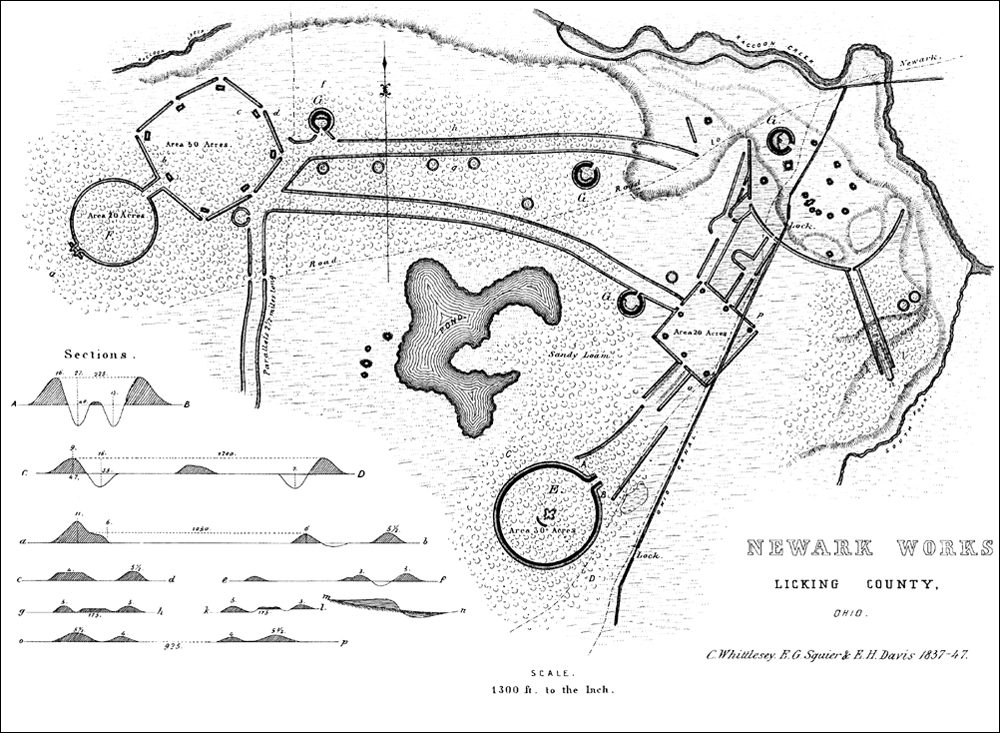
Map of the full Newark Earthworks Complex as mapped by Ephraim Squier and Edwin Davis in 1848 for the publication "Ancient Monuments of the Mississippi Valley."
The Octagon portion of the Newark Earthworks highlights the depth of planning and connection to the broader patterns of the universe embedded in the construction of Hopewell Ceremonial Earthworks. The Octagon is aligned with the lunar cycle and every 18.6 years the moon rises directly through the passageway linking the Observatory Circle and the Octagon. Each aspect of these earthwork complexes was created and designed with intention and care, a testament to the genius, cooperation and devotion of the American Indian peoples who created them thousands of years ago.
The earthwork sites in Ohio were sacred spaces not just for local American Indian peoples but groups of American Indians from all over North America. Exotic (non-local) materials were being brought by the people gathering at these sites from over 1800 miles away. American Indians coming to gather at the Hopewell Ceremonial Earthworks were bringing obsidian from the Rocky Mountain region, lightning whelk shells and shark teeth from the Gulf of Mexico and Atlantic Ocean, mica from the Blue Ridge Mountain Region and copper from the Upper Peninsula of Michigan. All these materials were transformed into ceremonial items that were laid to rest in these earthworks in Ohio.
Despite the fact that a great deal of the Newark Earthworks complex was lost to agriculture and development, two aspects of it remain: the Octagon and the Great Circle. The citizens of Licking County had the foresight to preserve these spaces. They are still used as places of coming together, sharing and celebrating but maybe in different ways than originally intended. Regardless, they are sacred spaces and hold a special place in the hearts of many. The local communities around the earthwork remember it as the county fairgrounds and as a place for family reunions and gatherings. But the site is especially meaningful to American Indian peoples. Their ancestors constructed the earthen walls that make up the Newark Earthworks and many other earthwork sites. They are the ones who lived, worked, played and celebrated on the land that is now Ohio for thousands of years.