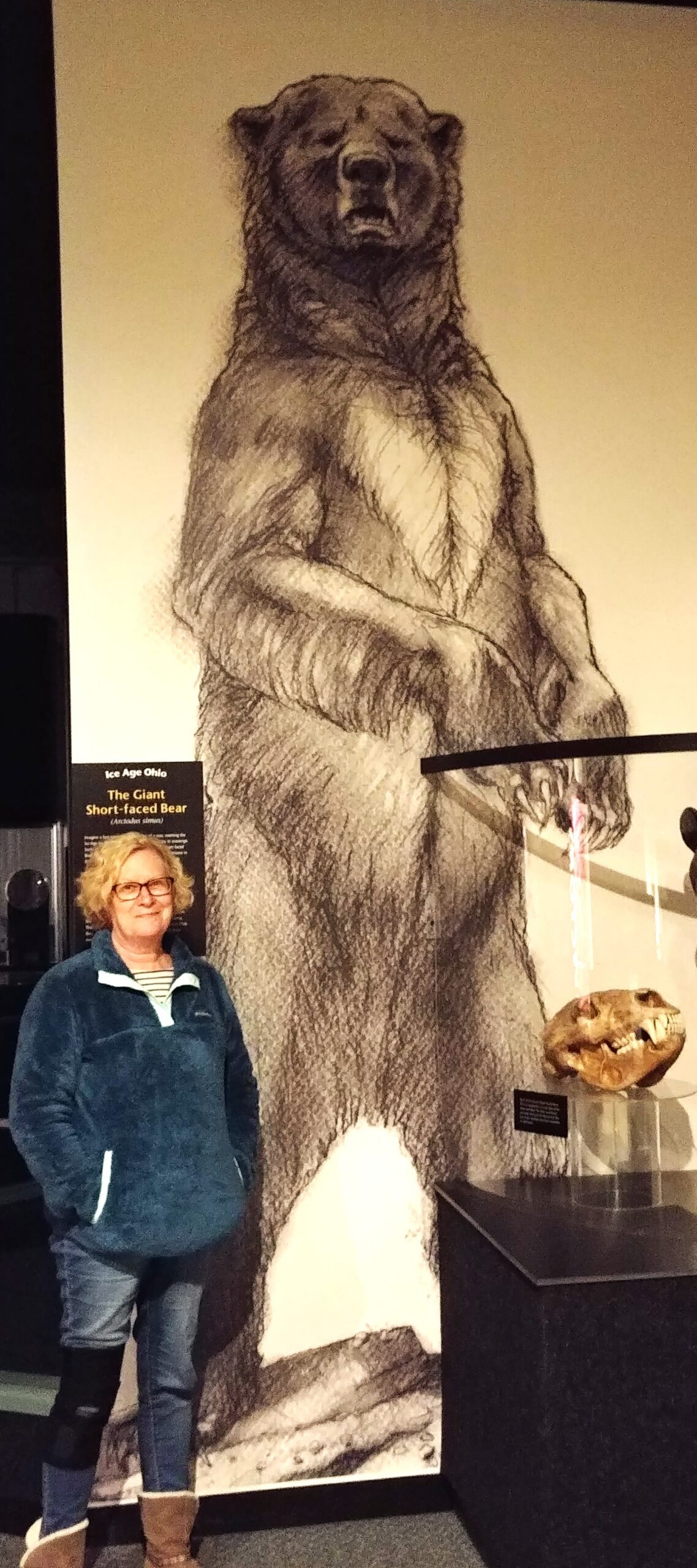
A life-size illustration of the Giant Short-faced Bear at the Ohio History Center.
It sounds like fiction: a bear weighing over half a ton and measuring up to five and a half feet at the shoulder when on all four feet; so tall that, if alive today, the tallest could stand on its hind legs and look down into a basketball hoop. A bear with an incredible sense of smell that could sense a mastodon carcass a mile or more away. A bear so intimidating it could scare a saber-toothed cat or pack of dire wolves off their kill. But it is not fiction. They lived right here in Ohio at the same time as the first Ohioans!
The Giant Short-faced Bear, Arctodus simus, was not only the largest bear in Ohio, but the largest land carnivore in North America during the Pleistocene epoch – the most recent Ice Age. The largest polar bears today are close to the short-faced bear in bulk but not as tall, standing at about 10 feet on their hind legs.
About 14,000 years ago, after the glaciers that covered a large part of Ohio during the late Pleistocene melted back, the habitat rebounded and animals moved back into the area. This repopulation included the short-faced bear and other large mammals we know as “megafauna,” including the mastodon, mammoth, ground sloth, giant beaver, and others. At its peak, the short-faced bear ranged from Alaska and the Yukon Territory to much of the United States and even into Mexico.
When first discovered, Arctodus simus was thought to be a giant predator feasting on the plentiful Ice Age fauna. However, recent research shows the leg bones of the short-faced bear, which are long and thin compared to modern bears, are not well adapted for running at high speeds for prolonged periods of time nor making sharp turns in pursuit of prey. Their cheekteeth are more adapted for an omnivorous diet than for shearing flesh. Together, this indicates the short-faced bear’s diet was probably like the modern grizzly. Depending on the season and availability, they eat a variety of plants and meat from scavenging and hunting. Interestingly, the closest living relative to the short-faced bear is South America’s spectacled bear, which is an omnivore that primarily consumes plants but will sometimes eat meat.
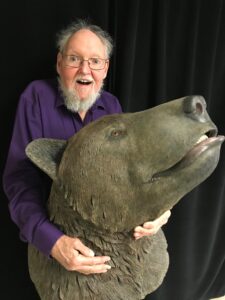
That is one big bear! Dale Gnidovec, Curator of the Orton Geological Museum at OSU, with a model of the Giant Short-faced Bear. Sculpture by David Might, Cincinnati Museum of Natural History and Science (photo by Patti Dittoe).
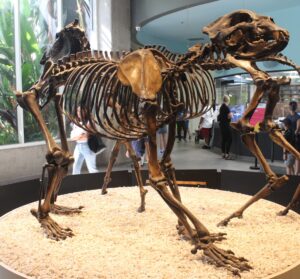
Skeleton of the Giant Short-faced Bear, next to a horse skeleton! (Creative Commons Attribution-Share Alike 4.0 International license).
What was it like for the first people in North America to live and share resources with such a massive bear? Apparently, it didn’t slow the migration of humans across the continent. Humans and short-faced bears lived together for many thousands of years as people spread across the Americas. A site in Texas uncovered skeletal remains of a short-faced bear with butcher marks from stone tools. Other sites in the U.S. have also uncovered remains found in association with human cooking. Ohio’s own Sheriden Cave site in Wyandot County, one of the richest Pleistocene sites in Ohio and the state’s only record of Arctodus, was found with Paleo-Indian artifacts.
Like many other megafauna, the short-faced bear went extinct near the end of the Pleistocene; the last individuals disappeared about 12,800 years ago. The reasons for this large extinction are many and varied, and the topic is still debated among scientists. However, for this large bear, the main causes appear to be changes in vegetation due to a shifting climate, lack of genetic diversity – which makes it more difficult to adapt to a shifting environment - and possible competition with humans.
So far there is just one record of Arctodus from Ohio, but I am sure more remains of this fascinating bear are out there just waiting to be found!