


From the years after the Civil War through the peak of the Great Migration, thousands of Black citizens arrived in Columbus. By the 1940s, Columbus’ Near East Side was a popular migrant destination and a flourishing hub for Black businesses, churches, social organizations, and other community institutions.
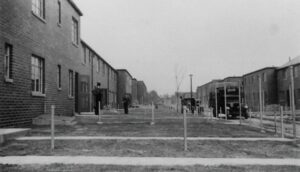 In the early twentieth century, increased racial segregation coupled with the expanding Black population caused overcrowding and deteriorating living conditions in Columbus’ constricted Black neighborhoods. In 1937, the Federal Housing Act provided federal funds for the construction of affordable public housing for Americans suffering from the impacts of the Great Depression. In 1940, the Columbus Metropolitan Housing Authority completed the construction of Poindexter Village, the city’s first affordable public housing project and one of the earliest in the nation. The 400-unit low-rise apartment complex was built exclusively for Columbus’ Black population.
Residents of Poindexter Village supported an adjacent flourishing business district of Black-owned companies and cultural institutions. The community nurtured its residents, producing many successful individuals. One notable resident was Amina Brenda Lynn Robinson, a world-renowned artist. Robinson, in her colorful mixed-media work, brought to life the vibrancy of the Poindexter Village community.
Even as Columbus’ civil rights leaders organized, Poindexter Village deteriorated. In 1952, the Livingston Heights Place subdivision was created.. Ten years later, Teakwood Heights, a Black subdivision of originally 13 homes expanded to 77 houses. A racially-mixed East Side suburb, Berwick, also developed. In the late 1960s, fair housing acts and ordinances eased some restrictions on housing for middle-class Black families, spurring them to buy houses in previously restricted areas.
The exodus of these residents from public housing left more financially vulnerable people behind, with their choices still limited by redlining and neighborhood isolation caused by highway construction. Public investment in affordable housing declined, resulting in a cut to services and maintenance in older public housing units. Many vacant units, too costly to repair, were boarded up. Due to this disinvestment, public officials called for the demolition and redevelopment of Poindexter Village.